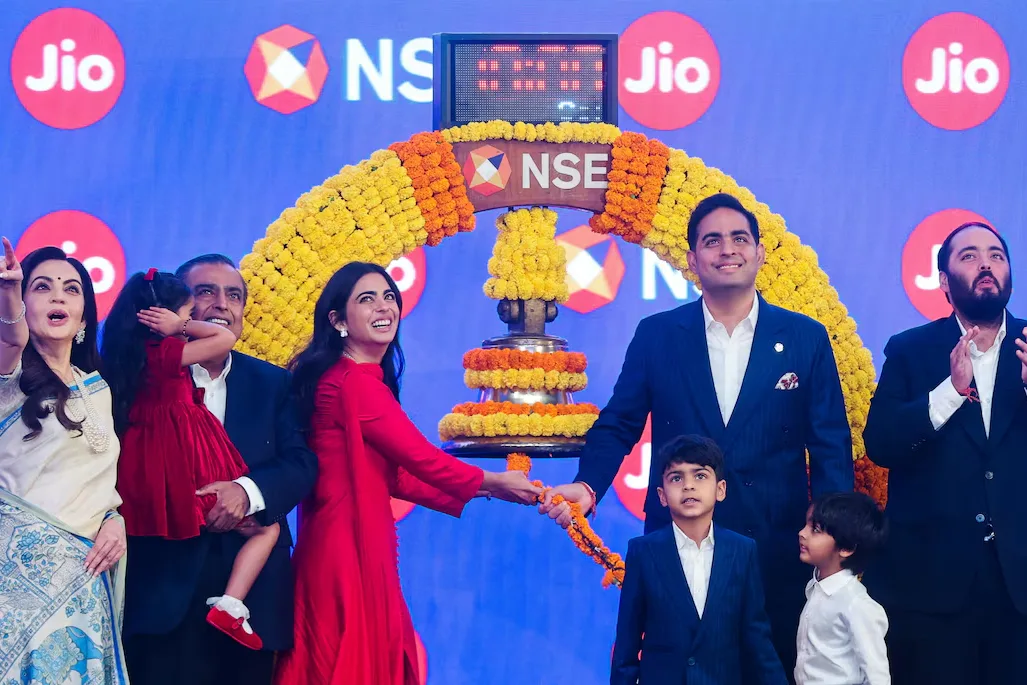
The company that made mobile data cheap enough for half a billion Indians is now a listed stock, and it opened 21% above its issue price.
Jio Platforms, the digital and telecom arm of Reliance Industries, debuted on the NSE and BSE on Wednesday, 28 October, at ₹1,358 a share against an issue price of ₹1,119. That is a listing premium of 21.36%.
The numbers
- Issue size: ₹30,213 crore, India's largest IPO, ahead of Hyundai Motor India's roughly ₹27,870 crore issue in October 2024
- Dates: bidding ran 21 to 23 October; shares listed on 28 October
- Demand: subscribed 22.19 times overall. Big institutions bid for 70.55 times their quota; retail investors about 2.7 times
- Value at listing: about ₹12.5 lakh crore, making Jio India's second most valuable listed company, behind its parent Reliance
- Small investors: a retail lot was 12 shares, or ₹13,428 at the issue price
Where the money goes
Every share sold was new. There was no offer for sale, so no existing shareholder cashed out, and the money goes to the company. Most of it, up to ₹27,500 crore according to DeshGujarat, will repay borrowings of Reliance Jio Infocomm, the telecom subsidiary. The rest is for general corporate purposes.
That makes this different from India's previous mega IPOs. Hyundai's and LIC's IPOs were offers for sale, where existing owners sold stakes.
The business behind it
Jio Infocomm had 524.4 million customers as of 31 March 2026, as per its offer documents reported by Groww. At the listing ceremony, Akash Ambani, chairman of Reliance Jio Infocomm, said Jio's platforms now serve more than 540 million customers, as per DeshGujarat.
In 2025-26, Jio Platforms reported revenue of about ₹1.47 lakh crore and a profit of about ₹30,050 crore.
The early backers
Meta and Google, which bought stakes in 2020 when Jio was valued at under $50 billion, are the big winners on paper. Global Venturing estimates Meta's 9.9% stake is worth about $10.5 billion at the IPO price and Google's 7.7% about $8.1 billion.
The fine print
Only about 27 crore new shares were sold, a small slice of the company. Motilal Oswal puts the free float at under 3%, as reported by IANS. A thin float can mean bigger price swings, because few shares trade.
It is also worth remembering history. HDFC Sky notes that Hyundai listed about 1% below its issue price, and LIC and Paytm each fell about 9% on day one. A strong debut is one day's mood, not a verdict on the company.
Why it matters
If you have a Jio SIM, you are now a customer of a listed company that answers to public shareholders every quarter. Brokerage Nomura, as reported by IANS, expects the listing to nudge Jio, as the market's price-setter, towards "steady tariff hikes that peers can follow". That is the part that could show up in your recharge bill.
The listing also shows Indian markets can absorb a ₹30,000-crore issue. With PhonePe, Zepto and Razorpay among the names in the pipeline, that matters for the next wave of companies young Indians use every day.
This is market news, not investment advice. GIST does not recommend buying or selling any stock.